Choosing a Mobile Panic Button System.
A neutral, non-gated decision framework for evaluating mobile panic button platforms. Use it whether you're shopping us, a competitor, or building an RFP.
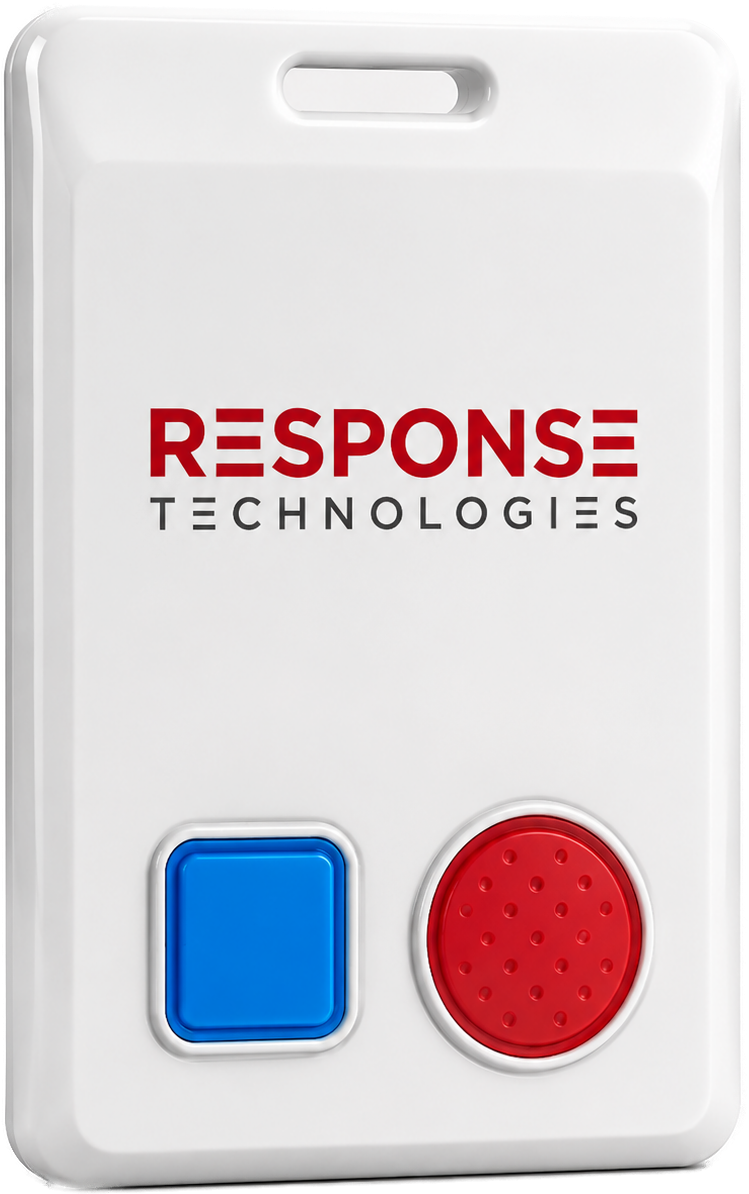
Six factors that decide the right system.
01
Indoor vs. outdoor vs. both
Indoor needs room-level RTLS precision. Outdoor needs cellular GPS. Mixed environments need a Unified system that fails over automatically.
02
Direct-to-911 routing
Does the system deliver activation, identity, and location directly into 911 CAD via RapidSOS, or does it stop at a monitoring center?
03
Battery life & TCO
Multi-year coin-cell battery vs. rechargeable. Add badge replacements, install costs, and per-seat licensing to compute true 5-year TCO.
04
Owned cloud vs. shared
A Response-owned cloud isolates your data and uptime. Shared multi-tenant clouds carry noisy-neighbor and data-comingling risk.
05
Compliance fit
Match the system to the standards you must meet: Alyssa's Law (K-12), Daniel Anderl Act (judiciary), HIPAA (healthcare), GSA Schedule (federal).
06
Deployment considerations
Anchor installation, Wi-Fi dependence, app distribution to BYOD vs. issued badges, integration with existing access control or radios.
Match the deployment to the threat surface.
Indoor RTLS
Outdoor GPS
Unified
Best for
Hospitals, courts, schools
Field, fleet, lone worker
Mixed campuses, hybrid teams
Location precision
Room / zone
3 to 10 m outdoors
Best available
Infrastructure
BLE anchors + gateways
Cellular, no install
Anchors indoors, cellular outside
Direct-to-911
Yes (via Centurion Cloud)
Yes (RapidSOS)
Yes (both paths)
Battery life
Multi-year coin cell
Rechargeable
Per-device
Buyer questions, answered straight.
Need help running the numbers?
We'll model TCO, deployment, and 911 routing for your exact environment.

Talk to Response Technologies
Tell us about your site and we'll respond within one business day.