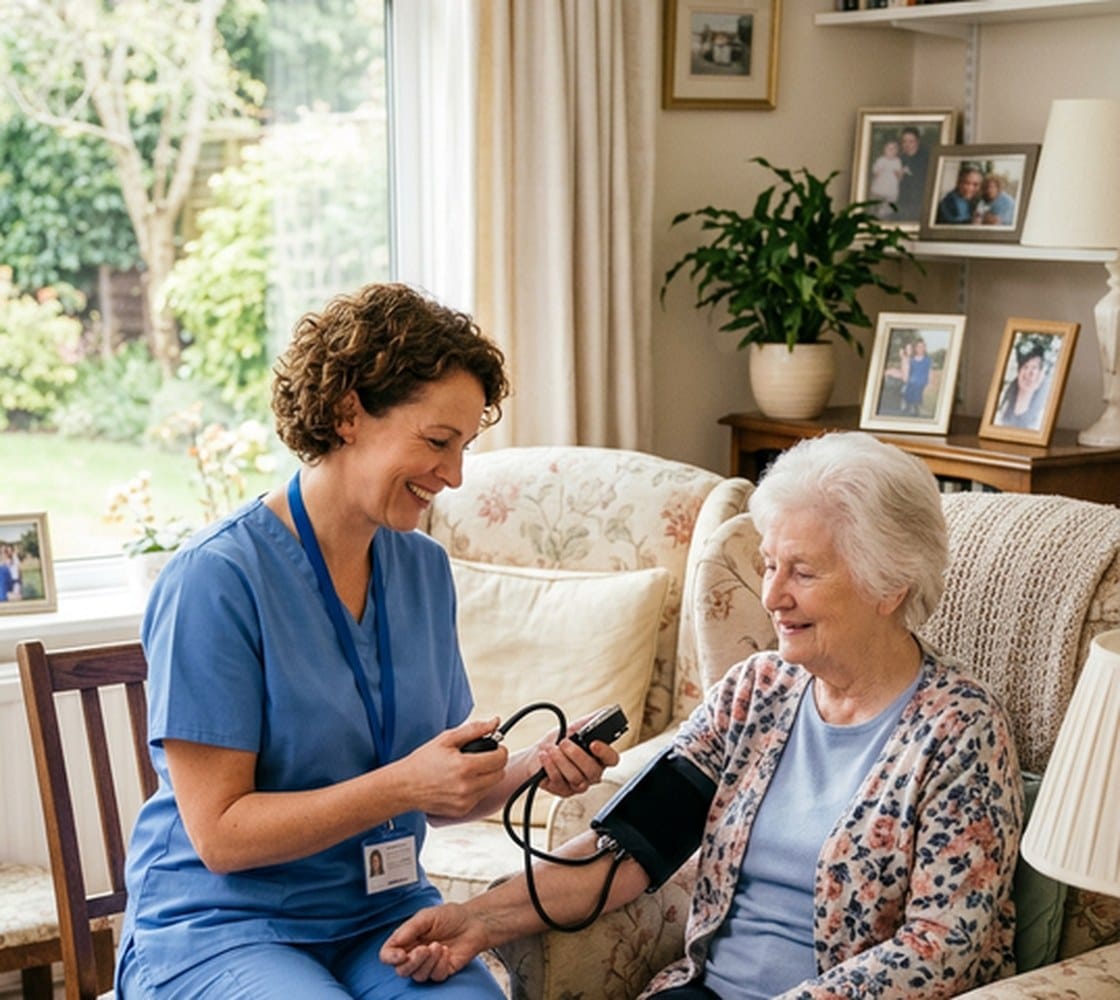
Executive Summary
Home healthcare workers are among the most vulnerable people in the care workforce, and among the least protected. They operate alone, inside patients' homes, without colleagues, panic buttons, security teams, or any of the response infrastructure that institutional settings take for granted. When something goes wrong, there is no one in the next room to hear it or help.
Healthcare workers are broadly five times more likely to experience workplace violence than workers in any other sector. Home health workers face that same elevated baseline risk, compounded by isolation, unpredictability, and a structural underinvestment in field safety that has persisted for decades. Most incidents go unreported. Most organizations are making safety decisions based on data that captures only a fraction of what their workers truly experience.
This white paper examines the workplace violence landscape specific to home healthcare: the risk environment, the reasons the data is incomplete, the financial consequences flowing from underinvestment in prevention, and the role of duress technology in closing the gap between an incident in progress and the help a worker needs.
The central finding is consistent with the broader healthcare literature: organizations that invest in prevention carry significantly lower costs across every category that follows an incident. In home health, the business case for that investment is even clearer because the cost of losing and replacing field workers, and the cost of operating without accurate data, compounds quietly and continuously in the background of every quarter.
Key Findings at a Glance
- 5x, Healthcare workers are more likely to be assaulted than those in any other sector.
- 62.4%, Of healthcare professionals have experienced some form of workplace violence (using reported data).
- 41%, Healthcare workers say they have minimal security in their workplace.
- $61,110, Average cost to replace a single bedside or visiting registered nurse.
- $3.9M, $5.7M, Annual hospital and health system losses attributable to RN turnover, per facility.
A Risk Environment Unlike Any Other Setting
The safety infrastructure that institutional healthcare workers depend on every day is invisible until it is needed: a colleague down the hall, a nurse call station, a security guard at the entrance, a supervisor within earshot, a rapid response team reachable in under a minute. Home health workers have none of it.
A home health aide or visiting nurse enters a patient's home as a solo practitioner. The environment is uncontrolled, unvetted in any consistent way, and entirely unpredictable. The risks they face span two distinct categories.
Physical Environment Hazards
Unlike a clinical setting designed and maintained with worker safety in mind, a patient's home is managed by the patient, or isn't managed at all. Home health workers regularly encounter poor or broken lighting in hallways and bathrooms, unsafe flooring, cluttered pathways, aggressive or untethered animals, and structural conditions (stairs, narrow spaces, lack of handrails) that create injury risk before any patient interaction begins. These are not exceptional circumstances. They are routine.
Interpersonal Hazards
Patient agitation, dementia-related behavioral episodes, active psychiatric crises, substance use, and caregiver conflict are among the interpersonal hazards home health workers encounter regularly. Neighborhood safety concerns, from high-crime areas to domestic situations that spill into the visit, add another layer of exposure with no analog in institutional settings.
The Isolation Factor
In a hospital or clinic, a worker facing an escalating patient has options: call for backup, use an emergency pull cord, step into a hallway, or summon security. A home health worker has none of those options. The worker must assess, de-escalate, and act entirely on their own, and then either continue the visit or leave, often with no formal mechanism to document what occurred or flag the home before the next scheduled visit.
Isolation is the defining feature of home health risk. There is no witness, no rapid response, and no one to notice that something has gone wrong. In the event of a genuine emergency, a patient becoming physically aggressive, a threatening third party entering the home, or a medical crisis affecting the worker, the worker's only recourse is their own phone, assuming they can reach it, and their own judgment, under pressure and without support.
This is not a gap that de-escalation training alone can close. Training improves a worker's ability to manage a situation. It does not change the fundamental reality that they are managing it alone.
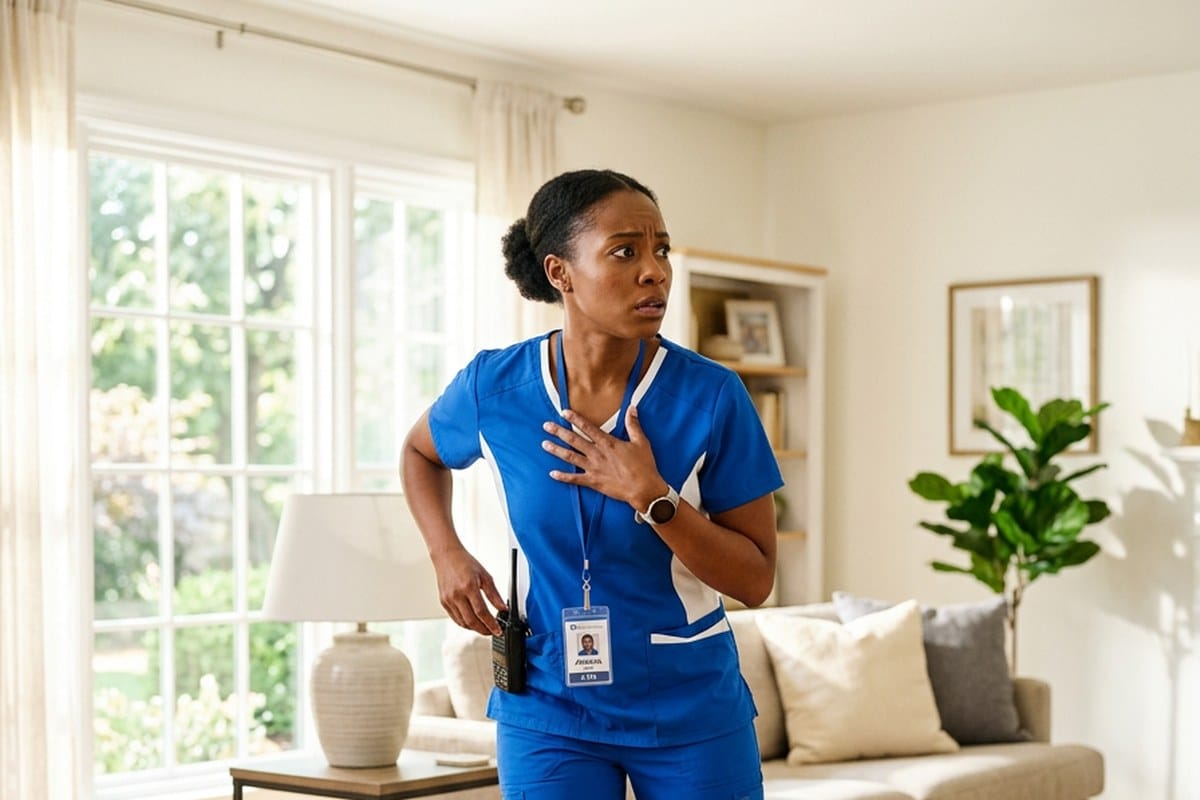 Home health workers operate as solo practitioners inside uncontrolled, unpredictable environments.
Why Home Health Violence Is Chronically Underreported
OSHA notes that actual workplace violence rates in healthcare are likely several times higher than formal data suggests. In home health, the gap is potentially wider than in any institutional setting. The reasons are structural, not accidental.
No Witness, No Pressure to Report
In an institutional setting, a violent incident may have witnesses, may trigger an automatic incident response, and may generate documentation whether the affected worker initiates it or not. In a patient's home, the worker is the only witness. If they choose not to report, or if they lack a simple way to do so, the incident disappears entirely. No record is created. No pattern is visible. No response is possible.
Violence Normalized as Part of the Role
Home health workers, particularly those serving clients with dementia or behavioral health conditions, frequently internalize aggression as an expected feature of the work rather than an incident to be reported. Scratching, hitting, and verbal abuse from patients with cognitive decline are treated as occupational normalcy. Such normalization is not a failure of individual workers. It is the product of an industry culture that has never adequately signaled these incidents as unacceptable and reportable.
Cumbersome Reporting Systems That Reward Silence
Incident reporting systems in home health are frequently paper-based, agency-portal-based, or require documentation at the end of a shift that includes multiple patient visits, drive time, and administrative tasks. The friction is high enough that workers under time pressure routinely skip it, especially for incidents that did not result in visible physical injury. Near-misses, verbal threats, and unsafe home conditions that created risk but did not produce a specific event are seldom formally recorded.
The Self-Reinforcing Cycle
When reports are filed, and no visible response follows, no safety review of the home, no change to the visit protocol, no acknowledgment from the organization, reporting drops further. Based on their experience, workers correctly conclude that reporting produces an administrative burden and no meaningful outcome. The organization ends up with data that reflects an increasingly small fraction of actual risk and makes resource and safety decisions accordingly. The gap between what is reported and what is occurring widens over time.
A Workforce Under Structural Pressure
Understanding workplace violence in home health requires understanding the workforce that experiences it. Home health workers, home health aides, certified nursing assistants, visiting nurses, and home health registered nurses, operate within a set of structural conditions that increase both their exposure to risk and their difficulty advocating for safety.
Compensation That Has Not Kept Pace
Home health workers remain among the lowest-compensated skilled roles in the care continuum. Median wages for home health aides and personal care workers have not kept pace with inflation, and in many markets, they have not kept up with the rising cost of living in the communities these workers serve. The workers delivering the highest-contact, most intimate care in uncontrolled environments without institutional support are consistently among the lowest paid in the healthcare system.
Scheduling Volatility and Benefit Inconsistency
Home health schedules are frequently unpredictable, with visit assignments changing based on patient availability, case closures, and agency staffing levels. Benefits such as health insurance, paid leave, and retirement contributions are inconsistently available, particularly for part-time or per-visit workers. The combination of pay instability and benefit gaps creates financial precarity that makes it harder for workers to advocate for themselves, push back on unsafe assignments, or leave organizations that fail to address safety concerns.
Limited Career Advancement
Career pathways in home health are narrow compared to institutional settings. The typical professional development infrastructure of mentorship, clinical ladders, specialty training, and leadership pipelines that exists in hospitals and health systems has a limited analog in field-based home health. Workers who want to grow professionally often must leave the sector entirely to do so. That dynamic contributes to attrition and concentrates less experienced workers in the field over time.
The Pandemic as an Accelerant
The COVID-19 pandemic did not create these structural problems. It removed the ability to ignore them. Home health workers were classified as essential, required to continue field work through periods of acute personal risk, and were frequently without adequate PPE, clear infection control protocols, or organizational support structures. The combination of elevated physical risk, workforce depletion from illness and resignation, and heightened patient acuity created conditions that accelerated attrition and burnout. The workers who remained absorbed more load with fewer resources.
The underlying conditions, inadequate compensation, scheduling volatility, isolation, structural underinvestment in safety, persist in full force. The pandemic made them visible, but it did not resolve them.
The Financial Impact of Underinvestment in Prevention
The financial consequences of workplace violence in home health do not appear in a single line item. They are distributed across workers' compensation claims, recruitment and onboarding costs, agency staffing premiums, lost institutional knowledge, and the compounding cost of chronic underreporting that prevents organizations from making accurate risk assessments. Together, they represent a substantial and largely invisible drain.
| Category | Annual Cost (Healthcare Broadly) | % of Total |
|---|---|---|
| Pre-event prevention costs | $3.62B | 19.80% |
| Post-event costs (workers' comp, lost productivity, litigation) | $14.65B | 80.20% |
| Total annual cost | $18.27B | 100% |
The Prevention-to-Response Ratio
Across healthcare broadly, the American Hospital Association estimates the total annual cost of workplace violence at $18.27 billion, of which $3.62 billion represents pre-event prevention and $14.65 billion represents post-event response costs. For every dollar spent on prevention, approximately four more are spent responding to the aftermath. In home health, where incidents are less likely to be formally reported, and the organizational response infrastructure is thinner, the post-event costs are frequently absorbed silently through turnover, workers' compensation claims processed without connecting them to a broader safety pattern, and lost productivity that never appears in a safety dashboard.
The Turnover Premium
Turnover in home health is among the highest of any sector in healthcare. Replacing a visiting registered nurse costs an average of $61,110 (2025 NSI Retention and RN Staffing Report). For home health aides and CNAs, replacement costs are lower per individual. However, the volume of turnover is significantly higher and the cumulative cost across an organization's aide workforce can exceed the nursing turnover cost by a substantial margin.
When field workers are replaced with agency or temporary staff, organizations pay a premium, typically 20 to 40 percent above the equivalent internal cost, for every visit covered by a non-permanent worker. Organizations running significant portions of their caseload on temporary staffing are paying that premium regularly, with limited visibility into how much of the underlying attrition is driven by safety concerns versus other factors.
What Does Not Appear in the Model
The standard financial model for turnover captures recruiting, hiring, onboarding, and the productivity gap during the transition. It does not capture what leaves with the worker: knowledge of the patient's home environment, established trust with the patient and their family, and informal protocols that make a high-acuity visit manageable. These attributes are not transferable. They must be rebuilt with each replacement, at a cost that includes both direct investment and the quality-of-care risk associated with an unfamiliar worker in a complex home environment.
Safety as a Quality Driver
The relationship between worker safety and patient outcomes is a reflection of the work structure and systems behind them. When home health workers feel protected, their capacity to deliver consistent, attentive care increases measurably. Research on healthcare worker psychological safety shows that workers who trust their organization to manage risk proactively are more likely to report concerns early, follow care protocols without improvising under duress, and maintain continuity with high-acuity patients across visits.
The financial connection runs in both directions: a 2025 peer-reviewed study in Home Health Care Management & Practice (Brumitt et al.) found that home health agencies with negative operating margins showed an 8-percentage-point decrease in average quality ratings, confirming that financial underinvestment and care quality deterioration are not parallel problems, they are the same problem at different stages. In home health specifically, where the clinician operates without immediate backup and builds care relationships over months or years, that organizational stability translates directly to patient experience and clinical quality.
Conversely, workers who feel exposed to unmanaged risk exhibit higher rates of visit rushing, care plan deviation, and early attrition, all of which compromise the quality that both regulators and payers are increasingly measuring. A Journal of Nursing Care Quality study found that two of the top three predictors of a patient safety grade were the physical safety and psychological protection of staff.
The Retention Cost That Safety Reports Do Not Capture
Workplace violence statistics track incidents. They do not track what happens to the worker after one.
When a home health worker is threatened, assaulted, or placed in a situation where they genuinely fear for their safety, the incident report eventually closes. The effect on that worker does not. Chronic exposure to violence, or to the sustained fear of it, produces the same burnout profile as chronic overwork: emotional exhaustion, declining engagement, and a growing sense that the job is not worth the risk. The worker who reaches that point is already leaving, whether they have said so yet.
- $61,110, Average cost to replace a single bedside or visiting registered nurse (2025 NSI Retention and RN Staffing Report).
- $3.9M, $5.7M, Annual health system losses from RN turnover, per facility; compounded by significantly higher aide and CNA turnover in home health settings.
- $289,000, Annual savings from a 1% improvement in RN turnover, per facility, per year, compounding over multiple years of sustained improvement.
- 1 in 3, Nurses leave within the first year of employment (approximately a 16.4% national RN turnover rate).
These figures live in HR dashboards. In most organizations, they are not connected to the safety environment that produced them. But for home health workers in particular, the safety environment is a primary driver. Workers who feel that their employer does not take their field safety seriously are more likely to leave than those who feel supported, not because they are more risk-averse, but because they have direct, daily evidence that the risk is real and the organizational response is inadequate.
HR directors and operations leaders who connect the retention data to the safety environment earlier than their peers tend to keep more of their people. They also tend to surface the accurate risk data that makes a compelling case for sustained safety investment, which further reduces attrition and improves the financial position. The connection runs both ways.
Closing the Gap: Duress Technology for the Field
A few conclusions follow directly from this data and are worth stating plainly before addressing the technology layer.
- Most home health organizations are making safety decisions based on an incomplete picture of their own risk. The organization that believes its workplace violence exposure is low may simply have a low-reporting culture, not a low-risk workforce. Building an accurate picture requires creating a reporting environment where workers can log incidents quickly and without friction, and then reviewing that data to identify patterns before they develop into a crisis.
- The financial model most organizations use to justify safety investment leaves out the highest cost: the ongoing expense of losing and replacing workers who no longer feel safe enough to stay. Connecting safety metrics to retention data, rather than treating them as separate dashboards, changes the business case substantially and typically makes it easier to secure the investment needed.
- Data alone does not stop an incident in progress. When a patient becomes physically aggressive, when a threatening third party enters a home, when a worker realizes they are in a situation that has escalated beyond their ability to de-escalate, the question is no longer whether the incident was measured. It is how quickly help can reach the person in trouble.
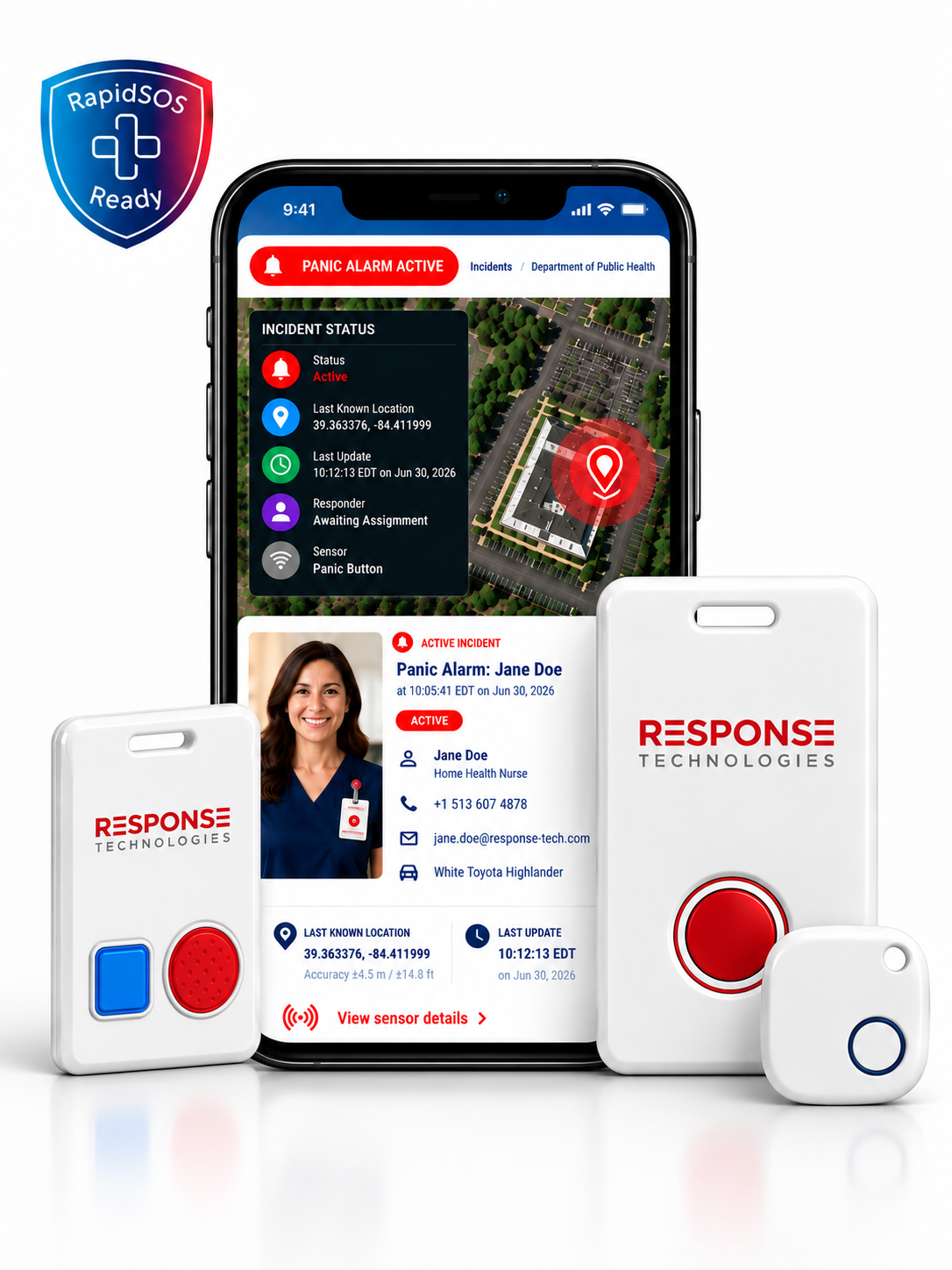 Centurion Anywhere: one button press transmits a field worker's GPS location to RapidSOS-connected dispatchers in under two seconds.
What Duress Technology Does in a Field Setting
In an institutional setting, duress infrastructure, pull cords, badge-activated alerts, and stationary panic buttons, is integrated into the physical environment. Home health workers have none of it. The standard backup is a personal cell phone: a device that requires the worker to unlock it, open an application, navigate to a contact or dial a number, and speak, all of which assume a level of calm and motor function that a genuine emergency does not permit.
A wearable duress solution fundamentally changes the response equation. A single button press requiring no phone, app, login, or menu navigation transmits the worker's GPS location to emergency dispatchers. The alert goes out whether the worker can speak or not. The response begins before the worker must explain anything.
Centurion Anywhere is the duress solution Response Technologies built for exactly this environment. One press transmits a field worker's GPS location to RapidSOS-connected dispatchers in under two seconds. No app. No menus. No explanation is required at the moment when explanation is impossible. The system communicates for the worker when the worker cannot communicate for themselves.
When workers believe the system works, they use it. When they use it, organizations gain the data they need to see their actual risk picture, not the fraction that surfaces through traditional reporting. The technology and the reporting culture reinforce each other, and together they make visible what has been hidden.
The interventions with the most consistent track record combine a strong reporting culture with technology that removes every barrier at the moment of need:
- Wearable duress devices activate with a single press and require no app or login.
- GPS location transmission works inside homes, in rural areas, and in environments where a verbal 911 call is not possible.
- Integration with professional dispatch networks ensures the alert reaches trained responders, not just a supervisor who may be unavailable.
- De-escalation training is grounded in field-specific scenarios rather than institutional environments.
- Visible response protocols give workers genuine confidence that an alert will produce a meaningful result.
Key Takeaways
- Home health workers face institutional-level risk without institutional safety infrastructure. The 5× elevated assault risk that applies to healthcare broadly applies to home health workers in full, compounded by isolation, uncontrolled environments, and no rapid response capability. This is the baseline. The safety strategy must start from it.
- Reported data captures a fraction of actual exposure. Underreporting in home health is structural. No witnesses, normalized violence, and cumbersome reporting systems mean the incident log reflects a small portion of what workers experience. Organizations that believe their risk is low based on reported data may simply have a low-reporting culture.
- The financial case for prevention is overwhelming, and most of the cost is hidden. For every dollar spent on prevention, approximately four are spent on post-event response. In home health, turnover costs, temporary staffing premiums, and lost institutional knowledge compound those costs further. Most of this expense does not appear in a safety dashboard.
- Safety and retention are the same conversation. Workers who do not feel safe leave. Connecting the safety environment to the HR and finance dashboards that track turnover costs changes the business case for safety investment and typically makes it straightforward to justify.
- A wearable duress system is the safety infrastructure home health has never had. Training and culture improve a worker's ability to manage a situation. Technology closes the gap between a situation that cannot be managed and the response that resolves it. For workers who are alone in the field, a single-press duress device that transmits GPS location to professional dispatchers in under two seconds is not an upgrade. It is the baseline that should have always been there.
Conclusion
The workers described in this white paper are delivering skilled, essential care in the most challenging conditions in the healthcare system. They do it without colleagues nearby, without emergency infrastructure, and in many cases without the organizational support that would give them confidence that their safety matters to the people they work for.
The organizations ahead of this problem are not the ones that have spent the most. They are the ones that connected culture, process, and technology before an incident forced the conversation. They developed reporting environments that surface risk before it escalates. They invested in training grounded in field conditions. And they gave their workers a way to summon help in the two seconds that matter most.
When a home health worker knows a one-button press can reach professional dispatchers with their GPS location in under two seconds, regardless of whether they can speak, regardless of whether their phone is in their hand, it changes what it means to walk into an unfamiliar home at the start of a shift. That is the difference between hoping the system holds and knowing it will.
About Response Technologies
Response Technologies develops personal safety solutions for healthcare workers operating in high-risk environments. Centurion Anywhere, the company's flagship duress platform, connects field workers to RapidSOS-linked dispatchers in under two seconds via a single button press, no app, no login, and no barriers at the moment when barriers matter most. Response Technologies partners with home health organizations, hospitals, and health systems across the United States to build safety infrastructures that combine wearable duress technology, reporting culture, and staff training into layered protection designed for the actual threat environments their workers face. The platform also provides administrators with full, detailed incident reporting.
844-811-8324 · www.response-technologies.com · info@response-technologies.com