There’s a logic to protection that transcends buildings and bureaucracy. When medical panic buttons became the gold standard for high-risk environments, direct lines to help without intermediaries were instituted, establishing a principle worth celebrating. In moments of crisis, the most vulnerable members of our society deserve a quiet protector to defend them when danger strikes.
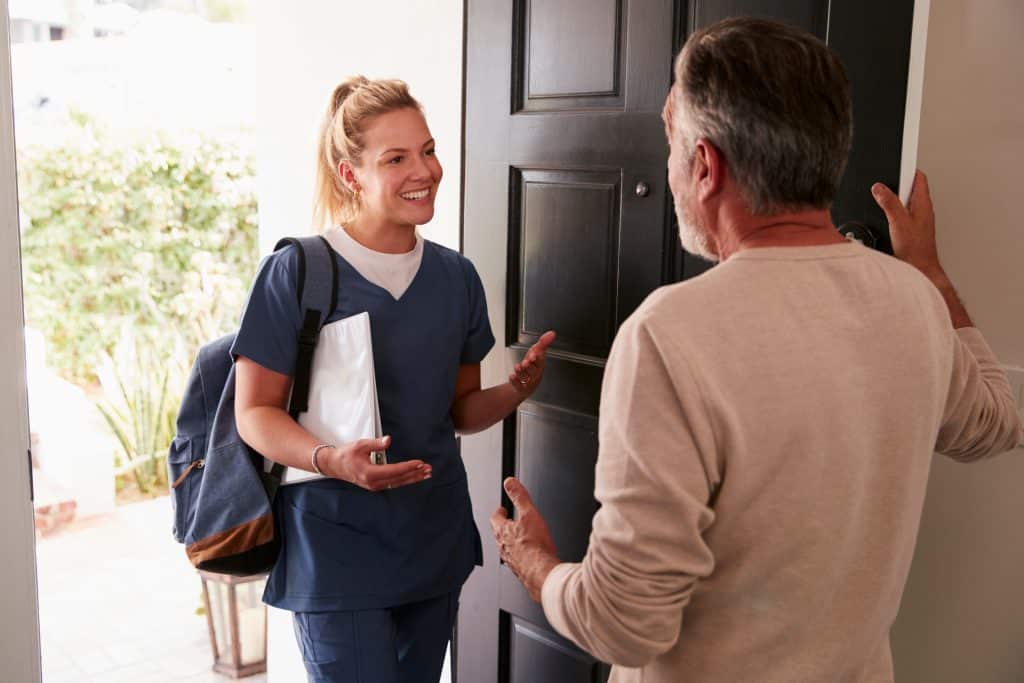
Home health workers are entitled to that same gold standard. The nurse visiting a patient’s apartment at dusk, the aide caring for a client in an isolated rural home. They are five times more likely to experience workplace violence than workers in other industries, yet they carry far less protection. If we accept that a teacher deserves immediate, silent access to help, why would we ask a lone worker to fumble with a phone app while in a time of crisis? That gap between risk and protection is why a medical panic button is no longer optional in home health care.
The New Standard of Care: Shifting Liability in Home Health
Smart leaders don’t wait for tragedy to enact lifesaving policies; they’re adopting critical protection principles today, before legislation forces their hand.
From Schools to Healthcare: The Alyssa’s Law Blueprint
Alyssa’s Law, which mandated silent panic buttons with direct lines to law enforcement in schools, established a powerful precedent: those working in high-risk environments deserve immediate, silent access to help without technological barriers.
No apps to open, no numbers to dial, no intermediaries to slow down response. That same logic now applies to home healthcare, where workers face violence rates five times higher than in other industries.
The ‘Joyce Grayson Law’ Effect: From ‘Occupational Hazard’ to Negligence
Connecticut’s Public Act 24-19, passed following home health aide Joyce Grayson’s death, represents a fundamental shift in how we approach home healthcare worker safety. What was once treated as an unfortunate “occupational hazard” is now recognized as preventable employer liability when proper safeguards aren’t in place, as OSHA’s investigation into Elara Caring demonstrated.
The law isn’t concerned about your budget constraints or implementation timelines. It cares that you knew home health workers were vulnerable and did nothing meaningful to protect them.
Why a Medical Panic Button Is Now an Operational Necessity
“Just call 911” is no longer a defensible safety strategy. It never really was. Telling a nurse under assault to unlock their phone, navigate to an app, and type their location while in a moment of crisis isn’t a safety protocol; it’s a liability waiting in the wings. A medical panic button is the baseline duty of care in this new legal reality.
Beyond Apps: Solving the ‘Fumble Factor’ in High-Stress Scenarios
The most sophisticated app ever designed becomes of little use when human physiology gets in the way — when adrenaline floods your system, and fine motor control vanishes. The complex checks and balances that offered a sense of comfort on implementation become useless in practice.
The 2-Second Rule: Why Consumer Mobile Devices Fail in an Attack
It was once thought that humans only experience “fight or flight” in response to trauma. But we actually respond through four primary patterns: fight, flight, freeze, and fawn (attempting to appease or comply with the threat). Each response is involuntary, instinctive, and varies by individual.
What’s crucial for safety planning: people with histories of early trauma are significantly more prone to dissociation during crisis moments. At this psychological detachment, they may “check out” mentally even while physically present.
They’re not showing weakness or poor training. It’s neurobiology. The brain, regularly overwhelmed by threats it couldn’t physically escape, learns to go offline to protect itself from psychological damage.
During any of these trauma responses, fine motor control degrades dramatically. Hands shake. Fingers fumble. Complex tasks become nearly impossible. Unlocking a phone, navigating menus, and finding the right app require cognitive bandwidth and dexterity that simply aren’t available when your nervous system is in survival mode.
We’re looking at 15 to 30 seconds minimum for smartphone-based alerts, assuming the person can even complete the sequence.
A nurse duress alarm on a lanyard or belt? Under two seconds. One familiar motion. One press. It works whether you’re fighting, fleeing, frozen, or dissociated. That design isn’t just faster, it’s humane. It meets people where they actually are during a crisis, not where we wish they’d be.
The ‘Silent Witness’ for the User: Speaking Without Words
Here’s what app developers miss: nurses under attack often can’t speak. The danger is in the room. Saying “I’m pressing my emergency button now” can escalate the situation.
A proper lone worker safety device automatically opens an audio channel. The nurse doesn’t announce anything. Dispatch hears the struggle, the threats, the chaos. They hear the location context, “I’m at 4250 Oak Street, apartment 3B,” without the nurse having to say a word. Silent witness protection isn’t a feature; it’s the entire point.
Privacy vs. Protection: Deploying Lone Worker Safety Devices Without ‘Big Brother’ Friction
Healthcare workers have every right to be thoughtful about the technology they’re asked to wear. They’ve seen well-intentioned systems become productivity monitors or compliance tools. Earning their trust is the foundation of effective protection.
Breadcrumbs vs. Event-Based Tracking: Respecting Staff Privacy
There’s a fundamental difference between surveillance and safety. “Breadcrumb” tracking monitors every movement, every break, every route. It paints a picture of productivity and compliance. It’s invasive and rightfully rejected.
Event-based tracking activates only when the medical panic button is pressed. The hospital collects information to save a life, not to monitor work breaks. Location data flows only during duress events. The rest of the shift? Complete privacy. This distinction matters to unions, to staff, to adoption rates.
Securing Buy-In from Nursing Leadership and Unions
Frame it correctly: this isn’t monitoring. It’s an on-demand lifeline. Pitch it the way you’d want it pitched to you: as protection that sits dormant until you need it, then delivers everything required to bring help to your exact location. When nursing leadership understands that distinction, resistance evaporates.
Hardware Matters: Maximizing Connectivity and Reliability
All mobile devices depend on cellular networks, but not all devices use those networks equally well. A dedicated lone worker safety device has one job. Your smartphone has 50.
The Bandwidth Battle: Dedicated Signals vs. Background Noise
Your nurse’s phone is simultaneously downloading Electronic Health Record (EHR) updates, syncing patient charts, pulling GPS traffic data, processing push notifications, and running background operating system (OS) updates. In weak coverage areas, all that digital noise competes for limited signal bandwidth.
A dedicated medical panic button sends one small packet of emergency data: GPS coordinates, device ID, timestamp. That’s it — no background processes stealing bandwidth. When cellular coverage is marginal, signal priority becomes survival priority.
Your nurse’s phone is constantly juggling:
- EHR downloads
- GPS navigation and traffic data
- Background OS updates
- Social media notifications
- Email syncing
- Push notifications from multiple apps
Operational Ease: No IT Headaches, Just Redundancy
These devices run on their own cellular connection — no hospital Wi-Fi required. A nurse grabs it, clips it on, and it works even when their primary phone is smashed, dead, or in their bag 10 feet away from the attack.
The Response: Direct Integration with First Responders via RapidSOS
Pressing a medical panic button into a void (hoping someone, somewhere, somehow got the message) isn’t protection. It’s performance. Real safety requires a verified response.
Bypassing the Phone Call: Immediate Data for Faster Response Times
Integration with platforms like RapidSOS eliminates the middleman. Your nurse’s duress alarm doesn’t route through an alarm company call center, then to 911, then to dispatch. It puts precise location data and relevant medical context directly onto the dispatcher’s screen. Seconds saved compound into minutes gained. Response times collapse.
The ‘Silent Witness’ for Dispatch: Prioritizing the Call
Here’s the dispatch reality: “check welfare” calls get lower priority than “crime in progress.” Silent witness audio instantly transforms call priority. Dispatch hears the assault happening. They hear the threat. They hear the environmental context. That audio verification escalates the response from “when available” to “send units now.”
Moving Your Organization from Compliance to True Staff Safety
Policy compliance protects your organization from lawsuits. Active protection protects your nurses from harm. They’re related, but they’re not the same.
You can check every Joint Commission box, satisfy every OSHA requirement, and still send vulnerable workers into dangerous situations with inadequate tools. Or you can deploy technology designed specifically to address the dangers home healthcare workers face daily.
Take the Next Step: Schedule a Mobile Safety Gap Analysis
The gap between your current protocols and actual staff safety is measurable. A consultation shows where your mobile workforce is exposed, where your liability is highest, and how lone worker safety devices can close those gaps before tragedy forces that conversation anyway.
See how Centurion Anywhere provides a lifeline where your current system can’t.
Frequently Asked Questions: Implementing Medical Panic Button and Safety Protocols
Can we practice using the buttons without the police showing up?
Yes. Muscle memory saves lives, so we encourage drills. The system features a simple “Test Mode” that allows your team to practice activation and verify signal integrity without dispatching first responders or incurring false-alarm fines.
Home health is messy. Can these devices handle fluids and drops?
Unlike smartphones that shatter or short out, our devices are built for the realities of healthcare. They’re water-resistant, drop-tested, and designed to be sanitized daily. Your nurses can wear them without hesitation while bathing patients or working in the rain.
Does this system help us with Joint Commission or OSHA compliance?
It’s a major step forward. While no single device guarantees compliance, deploying a silent, immediate duress alarm directly addresses OSHA’s General Duty Clause and The Joint Commission’s workplace violence prevention standards. It proves you’ve moved beyond policy to tangible protection.
GPS is great, but what if my nurse is in a basement or a 10th-floor apartment?
Integration solves this. When devices link to your scheduling system, a medical panic button press doesn’t just send raw coordinates; it cross-references with the nurse’s assignment. Dispatchers get the specific apartment number or floor, the critical vertical location that raw GPS sometimes misses. Police go to the right door, not just the right building.